Roof ReNU Free assessment

Roof rejuvenation · Utah County

Your roof isn't worn out. It's dried out.

Asphalt shingles don't fail because the fiberglass gives up. They fail because the oils inside the asphalt evaporate, and once those oils are gone the shingle turns brittle, sheds granules and cracks. Roof ReNU puts the oil back — inside the shingle, not painted on top.

Oils depleted Oils restored
Drag the handle — or use arrow keys 15-year-old shingle · illustrative
53%Less granule loss
66.7%Better cold-weather flex
5 yrsStill active in the shingle
1 dayTypical application

How a shingle dies

It's a slow leak of oil, not a sudden failure

Asphalt is a petroleum product. Sun, heat and Utah's freeze–thaw cycle pull the light oils out of it year after year. Here's the arc most roofs follow.

Years 0–8 · Flexible

Full of oil

The shingle bends without complaint. Granules are locked into a soft asphalt bed, and the mat sheds water exactly the way it was designed to.

Years 8–15 · Drying

Losing grip

Oils have started to leave. You see granules in the gutters and the first hairline checking on the sun-facing slopes. This is the window where rejuvenation does the most good.

Years 15+ · Brittle

Cracking and curling

Dry asphalt can't move with the deck. Edges curl, tabs crack, and bare spots expose the mat. Past a point, no treatment brings it back — replacement is the honest answer.

Rejuvenation is maintenance, not resurrection. The whole point is to treat a roof while it still has life in it — the same reason you change oil before the engine knocks.

Third-party testing

Measured at five years, not day one

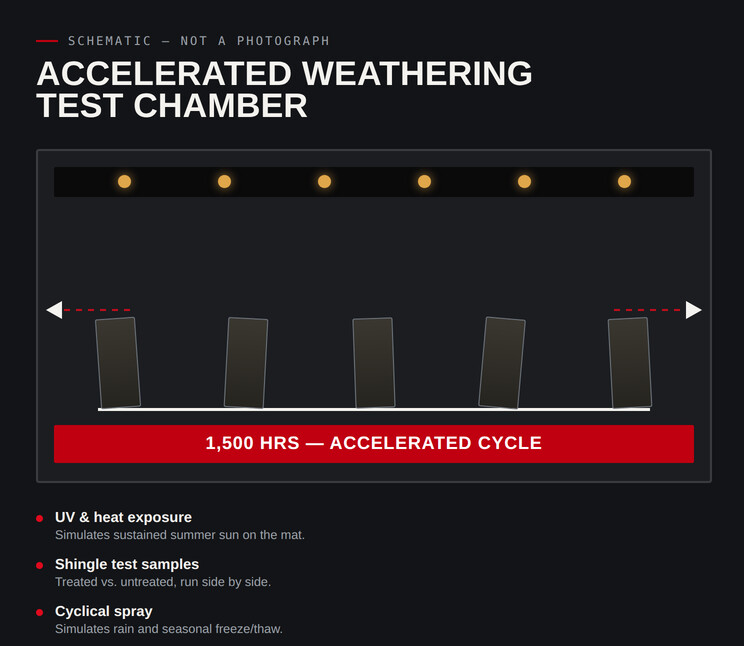
Independent testing by PRI Asphalt Technologies compared untreated 15-year-old field shingles against treated ones after a 1,500-hour accelerated weathering run — roughly five years of natural aging.
53%Less granule lossGranules stay bedded in the asphalt, which is what keeps UV off the mat.
66.7%Better cold-weather flexibilityPliability held to 5 °C instead of 15 °C — it matters every Utah winter.
24%Higher tear strength7.6 N untreated versus 9.4 N treated.
PRI Asphalt Technologies — 1,500-hour accelerated aging
PropertyUntreatedTreatedResult
Granule loss (g)1.430.6753% less loss
Tear strength (N)7.69.4Stronger mat
Pliability (°C)15566.7% better cold flex
Color change (ΔE)7.02Visibly refreshed

Testing performed in 2025 by PRI Asphalt Technologies on the rejuvenation product Roof ReNU applies, commissioned by the manufacturer. Results describe laboratory conditions on the shingles tested; your roof's age, pitch, exposure and condition all affect the outcome. We'll tell you honestly if yours isn't a fit.

Candidacy

Not every roof qualifies

We'd rather turn down a job than take money for a treatment that won't help. Here's roughly where the line sits — the assessment settles it.

Good candidate

  • Asphalt shingles, roughly 6–18 years old
  • Granule loss showing up in gutters and downspouts
  • Surface looks faded or chalky, especially south and west slopes
  • Shingles are intact and lying flat, just dry
  • Deck and flashing are sound, with no active leaks
  • You want to push replacement out and protect what's there

Not a candidate

  • Missing, cracked through, or badly curled shingles
  • Active leaks or visible decking damage
  • Storm or hail damage — that's an insurance claim, not a treatment
  • Wood shake, tile, slate or metal roofing
  • A roof already at or past the end of its service life
  • Previously coated or sealed with a surface product

The visit

Four steps, one day

1

Assessment

We get on the roof, check granule loss, flexibility and flashing, take photos, and give you a straight yes or no on candidacy.

2

Prep & protect

Debris cleared, valleys and gutters checked, landscaping and hardscape covered before anything is sprayed.

3

Application

Even, measured coverage across the whole roof plane. Most homes are done in two to four hours and dry the same day.

4

Warranty

You get before-and-after photos, coverage details in writing, and the warranty registered in your name.

The math

A fraction of a tear-off — and no dumpster in the driveway.

A full replacement means labor, disposal, a week of noise and several tons of shingles headed to the landfill. Rejuvenation is a single visit that buys years back on the roof you already paid for.

Every roof is priced by measured square footage and condition. The assessment is free and there's no obligation.

Get your number
Full replacementTypical range
Roof ReNU treatmentTypical range

Bars are illustrative of relative cost, not a quote.

Know what you're looking at

Three signs your roof is drying out

You can spot most of these from the ground with a phone camera. If any of them look familiar, the roof is worth a closer look.

Illustration

Granule loss

Bare, darker patches where the protective granules have washed off — and a gritty layer collecting at the bottom of your downspouts.

Illustration

Chalky fading

The south and west slopes look lighter and duller than the north side. That colour shift is oxidised asphalt showing through.

Illustration

Hairline checking

Fine cracks running across the tabs. Caught early this is still treatable; once cracks go through the mat, it isn't.

These are illustrations of what each condition looks like, not photos of our work. We'll replace them with before-and-after photos from our own jobs.

Free assessment

Find out if your roof qualifies

We'll inspect it, photograph what we find, and tell you plainly whether rejuvenation makes sense — or whether you're better off saving for a replacement.

Thanks — we've got it. Someone from the crew will call within one business day to set a time.

Questions, answered

Roof rejuvenation, without the pitch

Rejuvenation is newer than roofing itself, so most people meet it with healthy skepticism. Good. Here's what it is, what it isn't, and where it doesn't help.

01 · The basics

What it actually is

What is roof rejuvenation?

It's a treatment sprayed onto asphalt shingles that replaces the oils the asphalt has lost to sun and weather. Asphalt starts life as a petroleum product, flexible and slightly tacky. Over years of UV and heat, the light oils cook out of it. What's left is stiff and chalky — which is why old shingles crack, curl and drop granules.

Rejuvenation soaks into the shingle and puts some of that oil content back, restoring flexibility and helping granules stay bedded where they belong.

Isn't this just paint or a roof coating?

No, and the difference is the whole point. A coating or sealant sits on top of the shingle as a film. It hides the surface, can trap moisture, and in many cases voids the shingle manufacturer's warranty outright.

Rejuvenation goes into the shingle. There's no film left behind, no color layer, and nothing to peel. Once it dries, the roof looks like a roof — just darker and less chalky than it did.

Does it actually work, or is this a gimmick?

The mechanism is real asphalt chemistry — the same principle behind rejuvenators used on asphalt pavement for decades. Independent lab testing on the product we apply, run by PRI Asphalt Technologies on 15-year-old field shingles, found the treated shingles held onto significantly more granules and stayed flexible at colder temperatures after 1,500 hours of accelerated aging, roughly five years of weather.

What it can't do is repair damage. It's maintenance for a shingle that's drying out, not a fix for one that's already failed. Anyone telling you otherwise is overselling it.

How long does one treatment last?

Testing showed the treatment still measurably present in the shingle at the five-year mark. Roofs are typically re-treated on about a five-year cycle, and each cycle is meant to add life to the roof rather than reset it to new.

How much life you get back depends on where your roof started. A 10-year-old roof in decent shape has far more to gain than an 18-year-old one that's already brittle.

Will it change how my roof looks?

Usually yes, in a good way. Faded, chalky shingles darken back toward their original color as the oils rehydrate the asphalt. Lab measurement put the color change at 7.02 ΔE, which is a clearly visible refresh.

It is not a paint job, though. If your shingles are discolored from algae streaking rather than oxidation, rejuvenation won't remove that — that's a cleaning question.

Will it stop a leak?

No. Leaks come from flashing, penetrations, valleys, ice damming or physical damage — not from dry asphalt. If you have an active leak, that needs a repair first. We'll flag anything we spot during the assessment, but we won't sell you a treatment as a leak fix.

02 · Will it work on my roof

Candidacy

What kind of roof qualifies?

Asphalt shingle roofs — three-tab or architectural — that are structurally sound and drying out rather than falling apart. The sweet spot is roughly six to eighteen years old, with granule loss and fading but shingles still flat and intact.

What disqualifies a roof?
  • Missing shingles, cracks through the mat, or heavy curling
  • Active leaks or soft, damaged decking
  • Hail or wind damage — that belongs in an insurance claim
  • Non-asphalt roofing: wood shake, tile, slate, metal
  • Shingles already coated or sealed with a surface product
  • A roof genuinely at the end of its life

If yours falls in one of these buckets, we'll say so and you'll owe us nothing for the look.

My roof is 22 years old. Is it too late?

Often, yes. Age alone isn't the disqualifier — condition is — but by the early twenties most asphalt roofs have lost enough oil that the shingles crack when flexed. Putting oil into a shingle that's already fractured doesn't un-fracture it.

We'll still come look. If the answer is replacement, you'll get that straight, along with photos showing why.

My roof has moss or black streaks. Does that matter?

It matters for sequencing. Heavy moss holds moisture against the shingle and needs to come off first. Black streaking is algae, which is cosmetic and doesn't block the treatment, but a soft wash beforehand gives a better-looking result. We'll tell you which situation you're in.

Can it be applied to a brand-new roof?

There's no benefit yet. A new shingle already has its full oil content — the treatment has nothing to replace. Most roofs are worth their first treatment somewhere around the six-to-eight-year mark, once the sun has started pulling oils out.

03 · Application day

What happens at the house

How long does the job take?

Most single-family homes take two to four hours from setup to cleanup, depending on square footage, pitch and how much debris needs clearing first. It's a one-visit job.

Do I need to be home?

Not for the application itself, as long as we have access to the property and a clear path around the house. We do like you there for the assessment so we can walk you through the photos in person.

Is it safe around kids, pets, plants and gutters?

The product is bio-based and applied at a low volume, and we tarp landscaping, hardscape and anything sensitive before we start. We ask that pets and kids stay inside during application and off the patio until we've pulled the coverings — standard practice for any spray work.

If you have a rain-barrel or cistern collecting off the roof, disconnect it beforehand and let the first rain run off.

What if it rains?

We need a dry roof going on and a dry window afterward, so we schedule around the forecast and reschedule at no cost if the weather turns. Once it's cured, rain is a non-issue — that's the whole job.

Will it stain my driveway or siding?

Not when it's masked and applied properly, which is why prep is a step of its own rather than an afterthought. Overspray onto covered surfaces is contained, and anything that does reach a surface is wiped before we leave.

Does it smell?

There's a mild odor during application, similar to fresh asphalt, and it fades within a day. Closing windows on the treatment side during the visit is usually enough.

Can I walk on the roof afterward?

Give it a full day. After that it behaves like any asphalt roof — which is to say, be careful and preferably let someone with fall protection do the walking.

04 · Cost & warranty

The money questions

How much does it cost compared to a new roof?

Rejuvenation is priced per square foot and lands at a small fraction of a full tear-off and replacement, with no dumpster, no disposal fees and no week of crews on site. Your exact number depends on measured square footage, pitch and condition, so we quote after the assessment rather than over the phone.

What does the warranty actually cover?

The manufacturer backs the treatment with a five-year product warranty, and it's transferable if you sell the house — which is worth something at closing. You'll get the terms in writing before you pay, and we register it in your name after the job.

Read it. A warranty on the treatment is not a warranty on your roof, and any contractor who blurs that line is one to walk away from.

Will this void my shingle manufacturer's warranty?

Check your specific warranty document, because terms vary by manufacturer and by how old the roof is. Many shingle warranties are prorated to near-nothing by the age at which rejuvenation makes sense anyway. Surface coatings are the ones that commonly void coverage outright; a penetrating rejuvenator is treated differently, but we're not going to promise you something your paperwork decides.

Does it affect my homeowners insurance?

That's between you and your carrier, and answers vary widely. Some insurers care a great deal about roof age when they set premiums or decide on renewal; documented maintenance can help that conversation. Ask your agent directly before you count on any premium benefit — we can provide the invoice and photos for your file.

What if it doesn't work?

The honest framing: this is maintenance, and like any maintenance the results show up as things that don't happen. The warranty covers the product's performance as written. What we control is candidacy — and the surest way to be disappointed is to treat a roof that shouldn't have been treated. That's why we turn jobs down.

Do you offer financing?

Ask during the assessment and we'll walk you through current payment options. For most homes the treatment is a small enough ticket that financing isn't needed — that's rather the point of doing it instead of a replacement.

05 · Utah conditions

Local weather, local wear

Does altitude and Utah sun make this more relevant?

It does. UV intensity climbs with elevation, and our valleys pair that with hot, dry summers and a long freeze–thaw season. Both accelerate oil loss, which is why roofs here often look their age early on the south and west slopes while the north side still looks fine.

What about ice dams and snow load?

Rejuvenation doesn't prevent ice dams — those are an insulation and ventilation problem in the attic. What it does help with is the brittleness that makes cold shingles crack when snow shifts or someone rakes the eave. The lab testing showed treated shingles staying pliable at 5 °C where untreated ones stiffened at 15 °C.

Does it help against hail?

No treatment makes a shingle hail-proof. A more flexible shingle is less likely to fracture on impact than a brittle one, which is a real if modest benefit. But if you've already taken hail damage, that's an insurance claim and we'll point you there.

When's the best time of year to have it done?

Spring through fall, on a dry day with moderate temperatures. We book heavily in late spring and early fall, so if you're planning around a home sale or a pre-winter checklist, call earlier than you think you need to.

Where do you work?

Utah County and the surrounding valleys. If you're just outside the area, call anyway — we'll tell you honestly whether we can get to you.

Still deciding?

The assessment costs nothing and ends with a straight answer: treat it, wait a year, or start saving for a replacement. All three are real outcomes.

Book a free assessment